Schrödinger Equation in a Wedge Potential: Exact and WKB
The Schrödinger equation in a wedge potential is one of the “standard” problems in Quantum Mechanics — standard, but not routine, as its solution involves the Airy equation, which is likely to be unfamiliar, at least until this precise moment.
Because of this, it seemed interesting to look into this problem, and to find both its exact solution (involving the Airy function), but also to solve it using the WKB approximation: another topic that is “standard” in Quantum Mechanics classes, but less often seen in the real world. Here it provides an additional benefit, as a way to avoid the Airy function and to express the solution in terms of “elementary” functions.
The time-independent Schroedinger equation is:
$$ -\frac{\hbar}{2m} \nabla^2 \Psi(x) + V(x) \Psi(x) = E \Psi(x) $$
Consider the 1-dimensional case and let the potential be the one-sided wedge potential:
$$ V(x) = \begin{cases} V_0 x & x \ge 0 \\ \infty & x < 0 \end{cases} $$
Our problem then becomes finding the solution $\Psi(x)$ to the equation:
$$ -\frac{\hbar^2}{2m} \frac{d^2}{dx^2} \Psi(x) + (V_0 x - E) \Psi(x) = 0 \qquad \text{for $x \ge 0$} $$
Aside: Airy Function
The Airy function $Ai(x)$ can be defined as the solution of:
$$ \DeclareMathOperator{\Ai}{Ai} \frac{d^2}{dx^2} \Ai(x) = x \Ai(x) $$
with $\Ai(x) \to 0$ as $x \to \infty$ and $\Ai(0) = \frac{1}{3^{2/3} \Gamma(2/3)}$.
Also define the second derivative of $\Ai(x)$:
$$ \Ai_2(x) = \frac{d^2}{dx^2} \Ai(x) $$
Consider:
$$ \frac{d^2}{du^2} \Ai(u) - u \Ai(u) = 0 $$
and make the variable transformation:
$$ u = a x \qquad \Leftrightarrow \qquad x = u/a \qquad \Leftrightarrow \qquad \frac{d}{du} = \frac{dx}{du} \frac{d}{dx} = \frac{1}{a} \frac{d}{dx} $$
Then:
$$ \begin{align*} 0 &= \frac{d^2}{du^2} \Ai(u) - u \Ai(u) \\ &= \frac{1}{a^2} \frac{d^2}{dx^2} \Ai(ax) - ax \Ai(ax) \\ &= \Ai_2(ax) - ax \Ai(ax) \end{align*} $$
Similarly, if we let $u = ax - b$, we find that:
$$ \Ai_2(ax-b) - (ax-b) \Ai(ax-b) = 0 $$
Exact Solution
We seek the solution $\Psi(x)$ to the equation:
$$ -\frac{\hbar^2}{2m} \frac{d^2}{dx^2} \Psi(x) + (V_0 x - E) \Psi(x) = 0 \qquad \text{for $x \ge 0$} $$
Conclude: up to a multiplicative normalization constant (in the following always assumed to be 1),
$$ \Psi(x) = \Ai \left( \frac{2m}{\hbar^2} \left( V_0x - E \right) \right) \qquad \text{for $x \ge 0$} $$
where $E$ must be chosen to satisfy the boundary condition
$$ \Psi(x=0) = 0 $$
This means that $-\frac{2m}{\hbar^2} E$ must equal one of the zeros of $\Ai(x)$. Since all the zeros of $\Ai(x)$ lie to the left of the origin, this implies that $E > 0$.
$$ E_n = - \frac{\hbar^2}{2m} \zeta_n > 0 $$
where $\zeta_n$ is the n-th zero of $\Ai(x)$:
- $\zeta_0 = −2.33811 $
- $\zeta_1 = −4.08795 $
- $\zeta_2 = −5.52056 $
- $\zeta_3 = −6.78671 $
- $\zeta_4 = -7.94413 $
- $\zeta_5 = -9.02265 $
- $\zeta_6 = -10.04017 $
- …
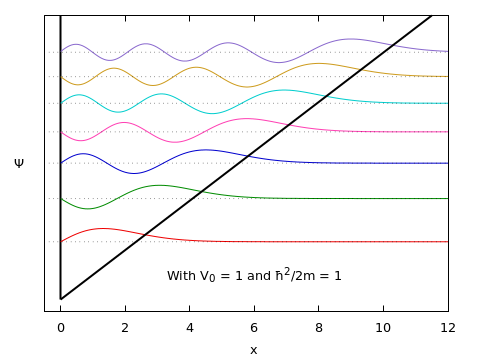
The figure is a bit misleading in that all solutions wiggle around 0 (indicated by dotted lines); it is the potential that is shifted deeper for each eigenvalue.
WKB Solution
One interesting aspect of the WKB approximation is that it gives an explicit formula for the wave equation and for the eigenvalues.
Assuming a potential well with turning points at $A$ and $B$, the expression for the wave function inside the potential well is (see, for instance, Jon Mathews and R. L. Walker: “Mathematical Methods of Physics”, 2nd ed, p37):
$$ \psi(x) \propto \frac{1}{\sqrt[4]{E-V(x)}} \cos\left( \int_x^{B} \sqrt{\frac{2m}{\hbar^2}(E - V(x))} \, dx - \frac{\pi}{4} \right) $$
This formula is appropriate for the oscillatory (bound) part of a state that falls off exponentially as $x \to \infty$ on the right.
(Some details of the WKB approximation are fairly subtle; maybe I’ll write them up some day. For now, let’s simply accept this formula, and the one below for the eigenvalues.)
For the eigenvalues:
$$ \int_A^B \sqrt{ \frac{2m}{\hbar^2} \left(E-V(x) \right) } \, dx = (n+\frac{1}{2}) \pi $$
where $A$ and $B$ are the turning points. In our case: $A=0$ and $B = E/V_0$.
In the following we will often need the integral (Bronshtein: “Handbook of Mathematics”, Integral 121, p1031):
$$ \int_A^B \! dx \sqrt{a + bx} = \left. \frac{2}{3b} \left(a + bx\right)^{3/2} \right|_A^B $$
The integral in the condition for the eigenvalues is then:
$$ \begin{align*} \int_0^{E/V_0} \sqrt{\frac{2m}{\hbar^2}(E - V_0 x )} dx &= \left. \frac{2}{3} \left( \frac{-\hbar^2}{2m} \frac{1}{V_0} \right) \left( \frac{2m}{\hbar^2} (E - V_0 x) \right)^{3/2} \right|_0^{E/V_0} \\ &= \frac{2}{3} \left( \frac{\hbar^2}{2m} \frac{1}{V_0} \right) \left( \frac{2m}{\hbar^2} E \right)^{3/2} \\ &= \frac{2}{3} \sqrt{ \frac{2m}{\hbar^2} } \frac{1}{V_0} E^{3/2} \end{align*} $$
This leads to:
$$ \frac{2}{3} \sqrt{ \frac{2m}{\hbar^2} } \frac{1}{V_0} E^{3/2} \doteq (n+\frac{1}{2}) \pi $$
or:
$$ E_n = \left[ \frac{3 \pi}{2} \sqrt{\frac{\hbar^2}{2m}} V_0 (n+\frac{1}{2}) \right]^{2/3} $$
With $V_0 = 1$ and $\frac{\hbar^2}{2m} = 1$, this yields for $E$:
| $n$ | $E_\text{WKB}$ | $E_\text{exact}$ | $E_\text{exact}-E_\text{WKB}$ |
|---|---|---|---|
| 0 | 1.77068 | 2.33811 | 0.56743 |
| 1 | 3.68317 | 4.08795 | 0.40478 |
| 2 | 5.17751 | 5.52056 | 0.34305 |
| 3 | 6.47947 | 6.78671 | 0.30724 |
| 4 | 7.66130 | 7.94413 | 0.28283 |
| 5 | 8.75795 | 9.02265 | 0.26470 |
| 6 | 9.78971 | 10.04017 | 0.25064 |
Performing the integral in the wave function, we find for the bound part of the wave function of the stationary states:
$$ \psi_n (x) \propto \frac{1}{\sqrt[4]{E_n-V_0 x}} \cos\left( \frac{2}{3} \sqrt{ \frac{2m}{\hbar^2} } \frac{1}{V_0} (E_n - V_0 x)^{3/2} - \frac{\pi}{4} \right) $$
For comparison with the exact solution, we need to fix the as-yet undetermined multiplicative constant. Normalization is difficult, because the WKB solution is not defined near the right-hand turning point. Instead, the constant has been selected, for each eigenvalue, such that the slope of the WKB solution at the origin equals the slope of the exact solution there.
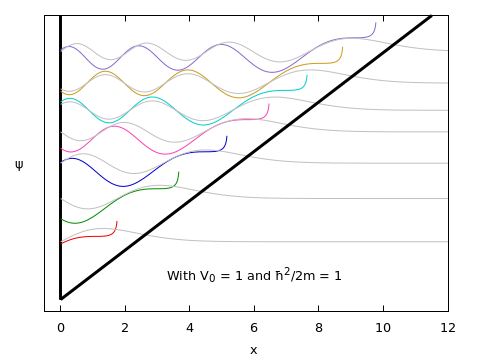
The graph shows the WKB wave function, together with the exact solutions. (The divergence of the WKB wave function near the right-hand turning point has been cut off.)
Sufficiently far away from the turning points, the WKB approximation is quite good. In particular, it gets the “phase” of the oscillation roughly correct, as well as the number of wiggles.
One problem with this solution is that the strict boundary condition on the left-hand side ($\psi(x) = 0$) is not taken into account at all. Possibly a better approach would be to re-cast the WKB solution to explicitly start at $x=0$ and proceed from there — which would get us out of the canned solutions and into the bespoke: an interesting topic for another time.